Diego Hernandez and Mariana had been married for three years when they finally got the news they had whispered about in prayers, grocery store lines, and in the dark before sleep.
A baby.
They lived in a cramped apartment in Queens, New York, where the radiator clanked all winter, the neighbors argued through thin walls, and the kitchen was so narrow only one person could stand in it at a time. They did not have much, but the apartment had always felt warm. Lived in. Loved.
Diego worked long days as a refrigeration technician, hauling tools through restaurant basements, fixing broken freezers in bodegas, and crawling behind old cooling units in buildings across the city. Mariana helped her aunt at a small bakery in Brooklyn, where she remembered every customer’s order and always came home smelling like sugar, yeast, and cinnamon.
The day Diego found out she was pregnant, something inside him softened and sharpened at the same time.
Every morning before work, he made sure she had something hot to drink, sliced fruit, toast, eggs, and anything else he thought the baby might need. After ten-hour shifts, even with his shirt damp from sweat and his hands smelling like metal and coolant, he still stopped at the market for yogurt, spinach, oranges, avocados, and whatever the doctor had suggested.
Their baby was already six months along.
Mariana’s belly grew rounder by the week, and her face had taken on that quiet glow Diego loved so much. He kept telling himself these were the happiest months of their lives.
Then Mariana started changing.
At first, it was small enough to excuse.
She said she was tired.
She stayed in bed later.
She asked Diego to bring her tea instead of getting it herself.
When he asked if she was alright, she smiled weakly and blamed the pregnancy.
Then the tiredness became something else.
Almost every day, from morning until night, she stayed on her side with a thin blanket pulled from her chest all the way to her feet. When Diego encouraged her to walk around a little, she would shake her head and say, “I’m just tired… this is normal. Pregnant women go through this.”
At first, he believed her.
Maybe the baby was getting heavier.
Maybe she was nauseated again.
Maybe her body simply needed more rest than before.
But with every passing day, fear began gathering in his chest like a storm he could not name.
At lunchtime, Mariana barely ate. A few spoonfuls of soup. Half a piece of toast. Sometimes a few bites of fruit. Then she would turn her face away and whisper that she wasn’t hungry.
At night, Diego would set a warm plate beside her, hoping the smell might tempt her. But Mariana would only stare at it in silence before pulling the blanket tighter around herself, as if she were guarding something beneath it.
What frightened him most was that she did not even want to get up to use the bathroom.
She would wait too long. And whenever Diego tried to help her sit up, her face went ghostly pale. Her fingers clutched the blanket so hard the fabric wrinkled in her fists.
One night, Diego came home late after overtime at a restaurant near Manhattan. Outside, car horns echoed through the street below, winter air slipped through the old window frame, and the distant call of a food cart vendor drifted up from the corner.
He opened the bedroom door.
Mariana was still there.
On her side.
In the same position.
Blanket pulled tightly from her belly to her feet.
The silence in the room felt wrong.
Diego set down a paper bag on the table. Inside was hot chicken soup and a box of sweet pastries from the bakery she used to love.
This time, she did not even turn to look.
His pulse began to race.
He sat carefully on the edge of the bed, trying not to scare her.
“Mariana,” he said softly, “are you hiding something from me?”
Her whole body stiffened.
For a long time, she said nothing. Then she gave a tiny shake of her head, but her shoulders trembled like she was fighting back sobs.
Something inside Diego cracked.
This was the woman he loved more than anyone. The woman carrying their first child. And suddenly she did not look stubborn or tired.
She looked like someone suffering in silence while he stood beside her every day and failed to see it.
He took her hand.
It was freezing.
“I’m not angry,” he whispered, voice unsteady. “But I can’t keep watching this. You barely eat. You won’t walk. You won’t let me help you. Mariana… you’re scaring me.”
Tears slid into her pillow.
“No,” she whispered. “Diego, please… don’t look.”
The words sent ice through his spine.
His eyes dropped to the blanket she was gripping so desperately. Every strange moment from the last few days came rushing together in one terrible second.
He drew in a breath.
“I’m sorry,” he said. “But I need to know.”
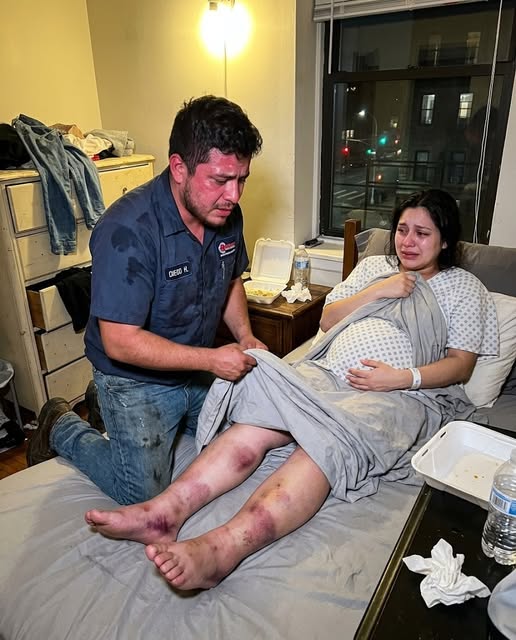
Then, with trembling hands, Diego lifted the blanket.
What he saw made him go completely still.
Mariana’s legs were terribly swollen, the skin stretched shiny and tight. Dark bruised patches climbed from her calves toward her knees. Around both ankles were deep purple grooves, as if the pressure and pain had been building for far too long.
One leg barely moved.
And under the hem of her loose nightgown, Diego saw angry red staining and swelling that should never have been there.
He stumbled back to his feet, his face draining of color.
“Mariana—oh my God. Why didn’t you tell me?”
She broke down, clutching her belly with both hands.
“I was scared,” she sobbed. “I was scared if we went to the hospital they’d say something was wrong with our baby. I thought if I stayed still… if I waited… maybe it would go away.”
Diego dropped to his knees beside the bed, choking on guilt.
He should have noticed sooner.
He should have pushed harder.
He should have understood this was not stubbornness.
It was terror.
He grabbed his phone so fast he nearly dropped it and called 911, his voice shaking so badly he had to repeat their Queens address twice.
“My wife is six months pregnant,” he said. “Her legs are swollen and bruised. She can’t walk. Please—please send help now.”
While they waited, Diego held Mariana against his chest and kept one hand over her stomach, whispering that she was not alone, that he was there, that he was sorry.
Then the sirens got closer.
Red and blue light flashed across the bedroom walls.
And when the paramedics rushed through the door, Diego knew with absolute certainty that the moment he lifted that blanket, everything in their lives had changed.
At the hospital, everything moved too fast.
Nurses cut away Mariana’s clothes. A doctor pressed hard against her swollen legs, then looked at another nurse and said, “Call maternal-fetal medicine now.” Diego heard words he had never heard before — severe preeclampsia, possible blood clot, internal infection, risk to mother and baby.
He felt the room tilt.
Then one of the doctors crouched beside Mariana and asked quietly, “Has this happened before? Any previous pregnancy loss? Any reason you were afraid to come in?”
Mariana started crying so hard she could barely breathe.
Diego stared at her.
Before?
She shook her head at first, then covered her face with both hands.
“When I was nineteen,” she whispered, “I got pregnant before I met Diego.”
The words hit him like ice water.
“My aunt found out,” she said, voice breaking. “She told me not to tell anyone. I started bleeding, and she said hospitals only make things worse and that if I went, everyone would know. I lost the baby at home.”
Diego went numb.
Mariana kept sobbing.
“I never told you because I was ashamed. And when the pain started this time… I heard her voice in my head again. Telling me if I went to the hospital, I would lose this baby too.”
A doctor looked up sharply.
“Your aunt told you not to seek care?”
Mariana nodded.
Then, just as Diego reached for her hand, a nurse rushed back in with the scan results.
The doctor’s face changed instantly.
“Diego,” he said, very carefully, “we need to move now.”
They wheeled Mariana away so fast Diego barely had time to kiss her forehead.
One nurse pushed papers at him. Another asked questions he answered without fully hearing himself. Allergies. Medications. Emergency contacts. Consent. Every word felt like it belonged to some other man standing in some other hospital while his own life was being cut open three doors down.
He sat in the waiting room with his elbows on his knees and his hands locked together so tightly his fingers ached. The fluorescent lights made everyone look fragile. Somewhere down the hall, a baby cried. A janitor rolled a bucket across the tile. The television in the corner flashed weather and traffic no one was watching.
Diego stared at the surgery doors and thought only one thing.
Please let them both live.
When the doctor finally came out, Diego stood so fast his chair nearly tipped over.
The doctor looked exhausted.
But not defeated.
“We moved in time,” he said. “Your wife is stable. The baby had to be delivered early, but there’s a heartbeat. Your child is alive.”
Diego’s knees almost gave out.
He covered his face with both hands and let out a broken sound that was half sob, half prayer.
Then the doctor added, quieter, “Another day and we might have lost both of them.”
That sentence stayed in Diego’s chest like a blade.
Mariana was taken to recovery.
The baby — their son — was taken straight to the NICU.
He was tiny. Far too tiny. A whole life fitting inside wires, plastic, and a body so small Diego was afraid even looking at him too hard might be too much. The nurse at the incubator smiled gently and told him he could place one finger through the opening.
Diego did.
His son’s hand curled weakly around the edge of his fingertip.
That was when Diego broke all over again.
For the next few days, he lived between Mariana’s hospital room and the NICU. He learned the names of machines he never wanted to know. He learned how long thirty seconds can feel when a monitor changes tone. He learned how fear can make food taste like nothing and sleep feel like betrayal.
Mariana cried often at first.
Not just from pain.
From shame.
That hurt Diego almost as much as seeing her in that bed.
Because even now, after the ambulance, after the surgery, after nearly losing everything, part of her still looked at him as if she expected blame.
So he gave her none.
Not once.
He sat beside her bed, held her hand, brushed hair from her face, and said the same words over and over until she started believing them.
“You are not dirty.”
“You are not broken.”
“You are not weak for being scared.”
“And you are not alone anymore.”
Slowly, she began to tell him the rest.
About her aunt.
About the old apartment.
About being nineteen and terrified and bleeding in secret while a woman she trusted told her hospitals were where poor girls went to be judged, shamed, and ruined. About carrying that fear for years until it had rooted itself so deeply inside her that when this pregnancy got dangerous, panic felt more familiar than help.
Diego listened to everything.
He did not interrupt.
He did not defend the aunt.
He did not ask why she kept it from him so long.
He understood now.
Fear taught young enough can live in the body like religion.
A hospital social worker visited the next afternoon. Then another. Questions were asked. Notes were taken. Mariana trembled through most of it, but Diego stayed beside her chair and kept one hand at the center of her back.
When the aunt called the hospital on the third day, Mariana looked at the number until her hands started shaking.
“Do you want me to answer?” Diego asked.
She took a breath.
Then another.
And for the first time since he had known her, he watched something hard and clear rise in her face.
“No,” she said. “I do.”
She answered.
He could hear the aunt’s voice through the phone even from where he sat — sharp, offended, already turning everything into someone else’s fault. But this time Mariana did not shrink.
“You almost killed me twice,” she said quietly.
The aunt must have started talking over her, because Mariana’s expression changed.
“No,” she said. “You listen now.”
Diego had never heard that tone in her before.
It was not loud.
It was stronger than loud.
“I was a child when you taught me to be afraid. I am a mother now. You will never come near me or my baby again.”
Then she hung up.
Afterward, her whole body shook.
Diego took the phone from her hands and held her while she cried, but these were different tears. Not the helpless kind. The kind that come when something poisonous finally leaves the body.
Their son stayed in the NICU for seven weeks.
Seven long weeks of alarms, whispered hope, small gains, setbacks, late-night coffee, hand sanitizer, and prayers spoken into plastic incubators. Diego still went to work when he had to, taking shifts where he could, then came straight back to the hospital with sore shoulders and metal-smelling hands. Mariana healed slowly. Her legs went down. The bruising faded. The swelling left. The fear did not vanish overnight, but it no longer ruled every decision.
When they were finally allowed to bring their son home, Mariana stood at the apartment window holding him in the morning light and cried so quietly Diego almost didn’t hear it.
He came up behind her and wrapped his arms around both of them.
“He’s really here,” she whispered.
“Yes,” Diego said.
The apartment was still small.
The radiator still clanked.
The kitchen was still too narrow for both of them at once.
But now there was a bassinet by the bed.
Tiny bottles drying beside the sink.
A blue blanket folded over the couch.
And a life they almost lost sleeping in the next room.
Sometimes, late at night, Diego still woke up sweating from the memory of that blanket.
Mariana did too.
But now, when fear showed up, it had to face both of them.
That changed everything.
A month later, as they sat together in the NICU follow-up clinic waiting room, Diego reached over and took her hand.
“No more hiding pain,” he said.
Mariana nodded.
“No more silence,” she whispered back.
He kissed her forehead.
Because that was what he had learned in the hardest way possible:
The most dangerous thing under that blanket was not only the swelling.
Not only the blood.
Not only the medical emergency building quietly beneath it.
It was the fear someone else had taught her to obey.
Diego thought his wife was only exhausted.
What he found when he finally looked was pain, yes — but also old shame, buried trauma, and a silence that had nearly cost all three of them their future.
The doctors saved Mariana.
The NICU saved their son.
But the moment that truly changed their lives happened earlier, in that cold Queens bedroom, when Diego decided that love meant looking anyway.