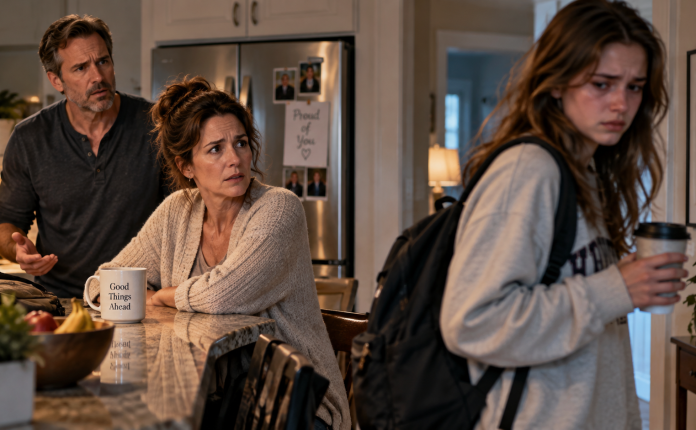
My husband fought me for everything in the divorce.
The house.
The cars.
The savings account.
Even the old camper we had used maybe twice and hated both times.
By the end of it, I was so exhausted from court dates, lawyer emails, mediation sessions, and hearing his mother call me selfish that I stopped caring about winning. I didn’t want revenge. I didn’t want fairness. I didn’t even want closure.
I just wanted peace.
So when Daniel smirked across the conference table and said he wanted the house because he “built that life,” I signed it over.
When he wanted the truck, I let him take it.
When he argued over patio furniture he had never once sat on, I said fine.
Take it.
Keep it.
Choke on it.
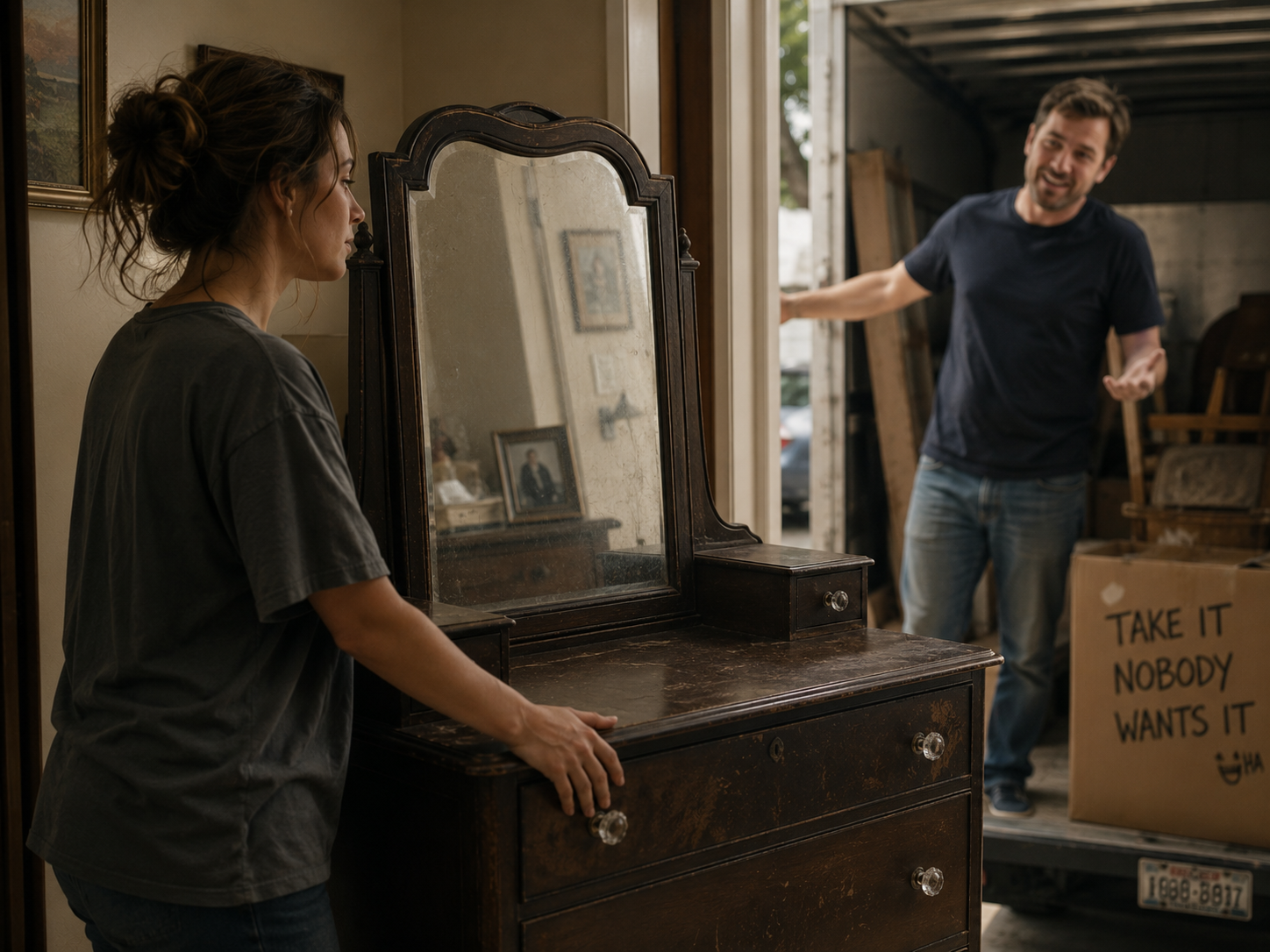
The one thing he didn’t fight for was his grandmother Rose’s old vanity.
It was a heavy, dark wooden thing with a cloudy mirror, carved legs, and drawers that stuck in the summer. It had sat in the hallway of his family’s house for as long as I had known them. Scratched. Unfashionable. Almost impossible to move. Daniel actually laughed when the movers carried it out.
“You can have the ugly thing,” he said. “Nobody wants it.”
I didn’t want it either.
Not really.
But Rose had been kind to me when nobody else in that family ever was. She used to sit in front of that mirror every Sunday morning, pinning up her silver hair and telling me not to let loud people make me small. When Daniel mocked me. When his mother corrected everything I did. When holidays turned into performances where I was always one wrong breath away from criticism, Rose would pat the seat beside her and tell me, “Quiet women see the truth first.”
So I kept the vanity.
For almost a year, it sat in the spare room of my little rental collecting laundry and dust while I tried to rebuild my life in two bedrooms with uneven floors, thin walls, and quiet evenings I was still learning not to be afraid of. I worked. I slept. I paid bills. I learned how to grocery shop for one. I stopped flinching every time my phone lit up. I stopped expecting Daniel to somehow invent one more reason I owed him something.
Then one gray afternoon, I finally decided to sell the thing.
I took photos.
Wiped down the mirror.
Opened the drawers to make sure nothing had been left behind.
The top drawer was empty.
The bottom one smelled like old perfume and cedar.
But the middle drawer kept jamming halfway, as if something behind it was catching.
I tugged once.
Twice.
Nothing.
Finally I got a flashlight, knelt down on the floor, and slid my hand into the narrow gap behind the drawer. My fingers brushed dust, rough wood, then something flat taped to the back panel.
My heart kicked strangely.
I peeled it loose slowly.
It was an old yellow envelope, sealed with brittle tape, with my name written across the front in Rose’s careful handwriting.
Not Daniel’s name.
Mine.
My hands started shaking before I even opened it.
Inside were three things.
A faded photograph.
A folded letter.
And a key taped to a bank receipt.
The photograph showed Daniel as a teenager standing beside his father in front of the old house. But behind them stood Rose, looking straight into the camera with an expression I couldn’t quite understand at first. Not warm. Not proud.
Knowing.
The bank receipt was dated two weeks before she died.
The letter began with one sentence that made me sit back hard on the floor.
If you are reading this, then Daniel has finally shown you who he really is.
I stopped breathing for a second.
Rose had died five years before the divorce. Five years before Daniel drained accounts, twisted facts, and told everyone I was unstable. Five years before he fought me for every plate, every dollar, every corner of the life we built.
I unfolded the rest of the letter with trembling fingers.
Rose wrote that Daniel was not the rightful heir to the house.
She wrote that his father had hidden documents after her husband died.
She wrote that the property Daniel had just “won” from me was never supposed to belong to him at all.
Then I saw the key taped to the receipt and the name printed beside it:
Safe Deposit Box 318.
At the bottom of the letter, Rose had written one final warning.
Do not tell Daniel until you have opened the box.
I sat on the floor of my spare room with that letter in my lap and the key pressed so hard into my palm it left a mark. For almost a year, I had believed Daniel took everything because he was cruel, greedy, and better at fighting dirty than I was. Now I was staring at proof that the one thing he valued most might never have been his to claim in the first place.
I did not call him.
I did not call his mother.
I did exactly what Rose told me to do.
The next morning, I went to the bank with the key, the receipt, my ID, and hands that would not stop shaking. The manager led me into a private room, brought out Safe Deposit Box 318, and left me alone.
Inside was a stack of documents wrapped in blue ribbon, an old deed, a copy of Rose’s will, and a second letter addressed to my attorney by name.
Rose had known.
She had known Daniel’s father forged paperwork after her husband died. She had known the family home had been placed into a trust meant to pass first to Daniel only if he met certain conditions: no fraud, no financial abuse, and no attempt to force a spouse out through deception.
If he violated those terms, the property was to pass to the one person Rose believed had protected the family when no one else would.
Me.
At first, I thought it had to be a mistake.
Then I saw my full legal name printed clearly on the final page. Rose had added it two months before she died. Attached were bank records showing Daniel’s father had hidden the trust documents and quietly transferred the house into his own name, then later into Daniel’s.
The house I signed away in the divorce was not a marital asset.
It was trust property.
And Daniel had never legally owned it.
My lawyer read everything twice, then a third time more slowly. When she finally looked up, her face had that dangerous calm attorneys get when they know the law is about to do exactly what it was written to do.
“We’re going back to court,” she said.
Daniel laughed when he was served.
He actually laughed.
“She’s desperate,” he told everyone. “She lost, and now she’s making things up.”
But he stopped laughing when the judge ordered the original records from the county archive, the bank, and Rose’s estate file.
He stopped laughing when his own father’s old signature was compared against the forged transfer.
He stopped laughing when the court froze the sale he was already trying to arrange behind everyone’s back.
His mother cried in the hallway and called me vindictive.
I looked at her and said, “No. Vindictive was watching your son steal a dead woman’s house and calling it inheritance.”
The case took months.
Daniel fought every page.
He said Rose had been confused.
He said the trust was outdated.
He said I had manipulated an old woman who had been kinder to me than her own family ever was.
But Rose had planned for that too.
Inside the deposit box was a video from her final appointment with her lawyer. She sat straight-backed in a navy blouse, wearing red lipstick and the pearl earrings Daniel’s mother had always wanted but never got. Her voice was perfectly clear.
“If Daniel ever breaks that girl,” Rose said into the camera, “make sure he does not profit from it.”
That was the moment his case collapsed.
Not dramatically.
Cleanly.
The court restored the trust. The house was removed from Daniel’s control. He was ordered to account for every dollar tied to the property, including rent he had collected from the guest apartment and repairs paid using what had once been our joint funds. By the final order, the home became mine — not because I begged, not because I out-schemed him, and not because anyone felt sorry for me.
Because Rose had seen the truth long before I did.
Daniel moved out with two suitcases and the same ugly smirk he wore during the divorce, only now it looked tired.
“Enjoy the haunted house,” he said.
I thought of Rose at the vanity, pinning up her silver hair and telling me not to let loud people make me small.
“I will,” I said.
The first thing I brought back into that house was the vanity.
I placed it in the front hallway where Rose had always kept it. I cleaned the cloudy mirror, polished the wood, and left the middle drawer exactly as it was — not because I wanted to keep the dust or the secret, but because I never again wanted to forget what almost got hidden forever behind something everyone thought was worthless.
I stood in front of that mirror the first night back in the house and looked at myself for a long time.
I looked older.
Tired.
Stronger.
Less willing to apologize for surviving.
Daniel thought he took everything valuable from me.
He forgot that some things do not glitter.
Some things wait.
Some truths survive inside old furniture, behind jammed drawers, protected by women who know exactly who deserves to find them.
Some inheritances are cash.
Some are houses.
And some are one dead woman’s final refusal to let a cruel man win.