The very first evening Lucía Reyes spent in the little house she had purchased for herself and her newborn daughter ended with a knock she knew would change everything.
Only three weeks had passed since Lucía gave birth by C-section. The incision still burned when she moved too quickly, and even lifting Emilia for too long made a hard ache spread through her middle. One hand always seemed to drift protectively to her abdomen now, while the other cradled her daughter against her chest, as if the baby’s tiny warmth could hold the rest of her life together.
The little blue house sat at the end of Bugambilias Street in Tlaquepaque, Jalisco.
It wasn’t grand.
A white iron gate.
A narrow porch.
A skinny lemon tree in the backyard.
Morning light that poured through the front room with more kindness than most people ever had.
There were no crystal chandeliers. No marble floors. No sprawling garden for visitors to admire. But to Lucía, that house was worth more than anything anyone in her family would ever understand.
It meant freedom.
Inside those walls, no one would scream at her from the kitchen. No one would go through her purse. No one would decide that because she had something, it automatically belonged to the rest of them too.
She had bought the house with the insurance settlement left behind when her husband, Andrés, died.
Seven months into her pregnancy, Andrés had been driving toward Chapala during heavy rain when a truck lost its brakes. The crash killed him instantly. At the Civil Hospital, someone handed Lucía a small plastic bag containing his wedding ring, his soaked wallet, and the receipt for a package of diapers he had bought only hours before.
That was the day she learned tears could fall without making a sound.
At the funeral, relatives offered condolences the way people hand out paper napkins. Quick. Dry. Rehearsed. Her mother, Doña Rosa, leaned close enough that only Lucía could hear her and said, “Now you’ll finally understand how much you need your family.”
Lucía understood perfectly what that meant.
It meant Maribel would “borrow” money and never repay it.
It meant Tomás would make himself comfortable in her living room.
It meant children running through the house while Lucía tried to heal.
It meant Doña Rosa deciding when she should eat, when she should rest, what she should say, and how grateful she was expected to be.
So when the paperwork for the blue house was completed, Lucía made sure every document listed only one owner:
Lucía Reyes.
And one day, after her death, everything would pass directly to Emilia.
No one else.
That evening, as the tamale vendor made his last round and the tortilla shop rolled down its metal shutter, Lucía carefully fixed two names to the mailbox.
Lucía Reyes.
Emilia Reyes.
She stood there for a long time staring at them until the letters blurred.
“We finally made it, my precious girl,” she whispered. “Your daddy made sure we would always have a home.”
At 10:30 that night, Lucía eased herself into an old armchair a neighbor had donated. Emilia slept beside her in a portable bassinet. The house smelled like fresh paint, baby soap, and tired hope.
Then her phone rang.
Mom.
That single word on the screen tightened her whole body.
She answered only because habit is harder to break than grief.
“Hello?”
“Lucía,” Doña Rosa said, without greeting, “Maribel is moving out of her apartment this Friday. Tomorrow morning we’re all coming to your house.”
Lucía sat up slowly.
“What do you mean, you’re coming to my house?”
“What else would I mean?” her mother said. “Your place has two bedrooms. I’ll take one with the children. Maribel and Tomás can use the other. You and the baby can sleep in the living room. You’re young. You’ll be fine.”
The warmth drained from Lucía’s fingers.
“No, Mom. I just had surgery. Emilia and I need rest. We need quiet.”
Her mother laughed.
“Oh, stop being dramatic. Families help each other.”
“This house belongs to me.”
“Your house?” Doña Rosa snapped. “The only reason you even have that house is because Andrés died. Don’t start acting like you’re better than everyone else.”
Lucía looked across the room at Andrés’s framed photograph resting on an unopened moving box. He was smiling in his faded denim shirt, holding a bouquet of flowers from San Juan de Dios Market, bought the afternoon they learned they were having a daughter.
Taking a slow breath, she said, “You’re not moving into my home.”
Her mother’s voice turned cold.
“Don’t make me embarrass you. We’ll arrive tomorrow morning. If you don’t like it, then you can leave. Emilia is my granddaughter too, and I have every right to be there.”
Then she hung up.
Lucía barely slept.
Every creak of the house made her chest tighten. Every glance at Emilia’s sleeping face reminded her exactly what she was protecting. By sunrise, she had locked every window, fastened the chain on the front door, and placed Andrés’s photograph beside the entrance like one last witness.
At exactly eight o’clock, tires crunched over the gravel.
Three cars.
Lucía moved the curtain aside and saw them.
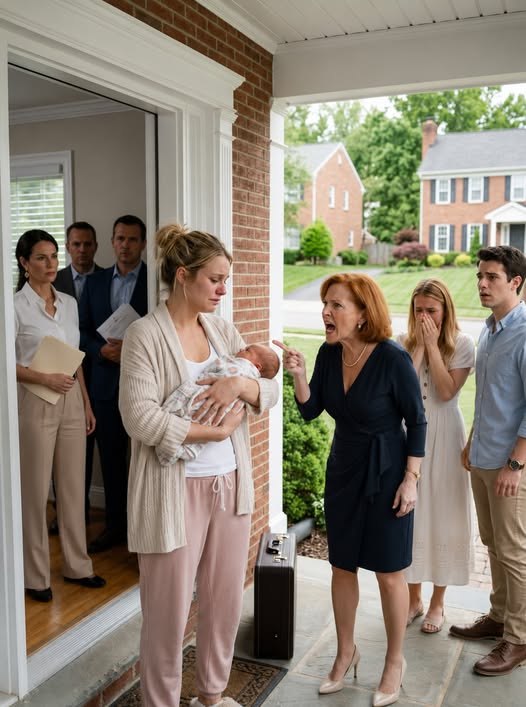
Doña Rosa first, purse clamped under one arm like authority itself. Then Maribel. Then Tomás. Two children. Four suitcases. A mountain of plastic bags.
They weren’t visiting.
They had come to stay.
Without waiting to be invited, Doña Rosa climbed the porch and pulled a key from her purse.
Lucía froze.
“How did you get a key?”
Her mother smiled.
“A mother always prepares.”
The stolen key slid into the lock.
It turned.
But the door did not open.
The chain held.
Doña Rosa’s smile vanished.
“Open this door immediately!”
Lucía stood in the entryway holding Emilia tighter against her chest.
“This is my home,” she said. “You are not coming inside.”
Maribel rolled her eyes. Tomás dragged the largest suitcase toward the porch as if this were already settled. Neighbors began drifting toward gates and windows, drawn by the shouting.
Doña Rosa raised her voice for the entire street.
“She’s keeping a grandmother away from her own grandchild!”
The whispering started.
Then Lucía stepped aside.
Behind her stood Miguel.
Tomás’s own older brother.
Dark suit.
Straight posture.
A thick folder in his hand stamped with official seals.
Beside him stood two uniformed police officers.
Miguel looked directly at Doña Rosa and said, “I think you should see these property records before taking another step.”
The confidence drained from every face outside.
Tomás looked at his brother first in confusion, then something closer to dread.
“Miguel,” he said, “what are you doing here?”
“What I should have done years ago,” Miguel replied.
He opened the folder slowly. Inside were the deed, the probate filing, a police report, and a notarized affidavit Lucía had signed before moving in. But the document he held back until last was the one that changed everything.
It was a certified statement from Andrés himself, signed months before the accident and held in trust by his attorney.
Lucía had not known it existed.
Neither, judging by their faces, had anyone else.
Miguel unfolded it carefully and read aloud.
“If anything happens to me, my wife Lucía Reyes and our daughter Emilia are to live without interference from either side of the family. No relative is to enter, occupy, claim, manage, or pressure them regarding any property purchased with my insurance or my estate. If any such attempt is made, I ask that this statement be treated as evidence of coercion and used to support legal protection.”
Silence fell so hard it seemed to flatten the whole porch.
Doña Rosa stared.
“That’s ridiculous,” she said too quickly. “Andrés would never—”
Miguel looked up.
“He signed it in my presence,” he said. “And in the presence of Attorney Salgado. He asked me to keep a copy if he ever feared his family would do exactly this.”
Tomás swore under his breath.
Maribel’s face changed from smug to frightened.
One of the officers stepped forward and addressed Doña Rosa directly. “Ma’am, this homeowner has already filed notice of attempted unlawful entry and unauthorized possession. The key in your hand is evidence. If you try that lock again, you’ll be arrested.”
Doña Rosa actually laughed.
A brittle little sound.
“You would arrest a grandmother?”
The officer did not blink.
“I would arrest anyone trying to force entry into a private home.”
That was the first moment Lucía felt something inside her unclench.
Not relief.
Not yet.
But certainty.
Doña Rosa tried a different tone then, soft and wounded, the one that used to make everyone around her feel guilty for breathing too loudly.
“Lucía,” she said, “you’re doing this because you’re confused. You just had a baby. You’re emotional.”
Miguel pulled another paper from the folder.
“This one,” he said calmly, “is from the obstetrician at Civil Hospital. It confirms that stress, forced displacement, and postpartum instability would pose a medical risk to Señora Reyes during recovery.”
He handed it to the officer.
Then he looked at his brother.
“And this,” he said quietly, “is the part where you stop standing behind Mama and pretending you didn’t know what this was.”
Tomás looked away first.
That told Lucía plenty.
Maribel, cornered by silence, hissed, “So what? She has two bedrooms. We’re family.”
Lucía answered before Miguel could.
“No,” she said. “You are relatives. Family doesn’t arrive with stolen keys and suitcases.”
That landed.
Because even the neighbors heard it.
And neighbors, once given the truth clearly enough, tend to know exactly where to place their sympathy.
Doña Rosa made one last attempt.
She took a step toward the door, chin raised, and said, “Emilia is my granddaughter. You can’t keep her from me.”
Miguel’s face hardened.
“No,” he said. “But a judge can.”
Then he handed Lucía another document.
An emergency petition already prepared, naming Doña Rosa, Maribel, and Tomás as parties barred from entering the property or making any custodial claim until a hearing. Lucía stared at it, then at Miguel.
“You did all this?”
He shook his head.
“Andrés did,” he said. “He just asked me to be ready if the day ever came.”
Lucía nearly cried then.
Not from fear.
From the terrible, beautiful knowledge that Andrés had seen it coming and still found a way to protect her after he was gone.
At last, Doña Rosa seemed to understand that shouting was not going to bend the law. She looked around the porch, the neighbors, the officers, her own son’s brother standing on the wrong side of the door, and realized she had no audience left willing to mistake force for love.
“You’re turning everyone against me,” she said.
Lucía looked down at Emilia, sleeping through the whole storm.
Then back at her mother.
“No,” she said softly. “You did that yourself.”
The officer asked them to leave the property.
This time, they obeyed.
Not gracefully.
Maribel muttering.
Tomás yanking suitcases back down the steps.
Doña Rosa looking over her shoulder as if indignation alone might still unlock the door.
The cars backed out of the drive one by one.
When they were gone, the street stayed still for a few seconds.
Then one neighbor, Doña Elena from across the way, lifted a hand and called, “You did right, niña.”
Another neighbor nodded.
A third said, “If you need anything, we’re here.”
Lucía closed the door then and leaned against it with her eyes shut.
Miguel fastened the chain again.
The officers took the stolen key, made their notes, and left quietly. One of them nodded to Lucía on the way out, not with pity, but respect.
When the house was finally silent again, Miguel set the folder on the table and looked around the little front room.
“He loved this place for you,” he said.
Lucía touched Andrés’s photograph with her fingertips.
“I didn’t know he was afraid of this.”
Miguel gave a sad little smile.
“He wasn’t afraid. He was prepared.”
That night, after he left, Lucía fed Emilia in the armchair under the front window. The house was small, yes. The floors creaked. The kitchen was barely bigger than a hallway. The lemon tree outside looked too thin to survive another dry season.
But inside those walls, no one was shouting.
No one was taking.
No one was deciding for her.
No one was measuring how much of her life belonged to them.
Only Lucía.
Only Emilia.
Only the quiet Andrés had fought to leave behind.
Before bed, she walked to the mailbox and looked again at the two names fixed there in black letters.
Lucía Reyes.
Emilia Reyes.
This time, when tears came, they didn’t come from fear.
They came from understanding.
Her mother had arrived with suitcases, relatives, and a stolen key, certain blood alone gave her the right to claim whatever she wanted.
She had no idea that behind the chained door waited the one thing she had never been able to bully, shame, or silence.
Proof.
And sometimes proof is stronger than grief.
Stronger than guilt.
Stronger than family.
Sometimes it is the only thing that keeps a woman and her daughter safe long enough to become a life of their own.