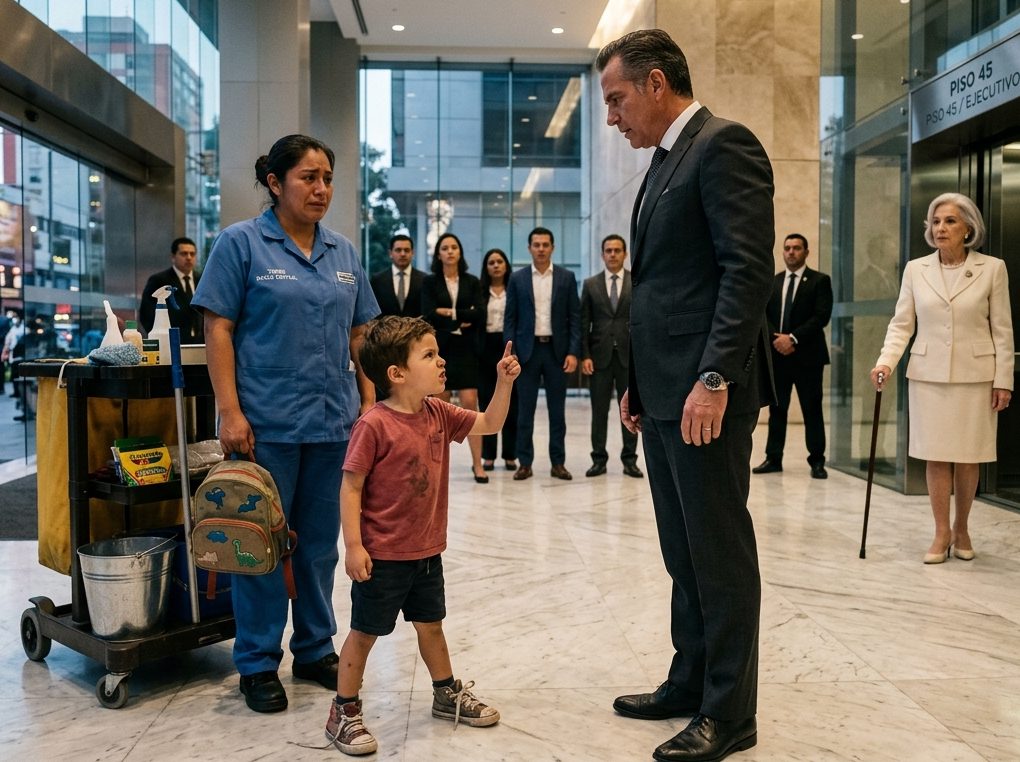
The boardroom was colder than the lobby, all glass walls and silence and polished wood so expensive Irene felt scared to touch the chair. Benji sat on her lap, suddenly quiet now that the adrenaline had passed, his small fingers twisted into the fabric of her cleaning uniform. Lorenzo stood near the window, jaw tight, while Camila Santillán remained at the head of the table, studying all of them with unreadable calm.

“Tell me exactly what happened,” she said.
Irene did. Not dramatically. Not cleverly. Just plainly. The daycare emergency. The unpaid rent. The fact that she had almost finished her shift and only wanted to make it through one more morning without losing the job that kept food in her son’s lunchbox. She spoke with her eyes lowered because years of poverty had taught her that truth often sounds like excuse when spoken upward. By the time she finished, her voice had gone hoarse.
Camila nodded once and turned to her son. “And you,” she said. “What part of that justified humiliating her in the lobby?”
Lorenzo straightened. “There are rules. We cannot have staff bringing children into the building, especially in front of investors. It affects the image of the company.”
Camila’s expression did not change.
“The image of the company,” she repeated. “Do you know what affects the image of a company more than a cleaning lady’s child?”
Lorenzo said nothing.
“A powerful man forgetting who polished the floor beneath his feet.”
The room went still. Irene felt Benji shift in her lap. Even he seemed to understand that something heavy had just entered the air.
Camila rested both hands on the head of her cane. “You were six when I cleaned office stairwells at night,” she said to Lorenzo. “Do you remember that?”
His face tightened.
“I remember.”
“No,” she said softly. “You remember the version of our life you prefer. I remember carrying you asleep on my shoulder because I had no one to watch you. I remember scrubbing marble floors pregnant, hungry, and terrified I would be fired if anyone saw my child in the hallway. The only reason you ever stood inside buildings like this one is because women like her kept going when they had every right to collapse.”.

Irene stopped breathing.
Lorenzo’s eyes flickered, just once, toward the floor.
Camila turned to Benji then, and her voice gentled. “What else did my son do that made you angry?”
Benji hesitated, then said it the way only children can—simple, direct, devastating.
“He made my mommy look small.”
For the first time, Lorenzo flinched.
Silence hung over the room for several seconds. Then Camila said, “Thank you, Benji. That was honest. More honest than most board reports I’ve read this year.”
A sound escaped one of the assistants near the door. Not laughter exactly. More like surprise.
Then Camila faced Irene. “Mrs. Ochoa, you are not fired.”
Irene’s whole body went slack with relief so sudden it hurt.
Camila continued. “In fact, starting next month, you will no longer report through outsourced cleaning management. You will join building operations directly, with benefits, healthcare, and emergency childcare assistance. And your salary will be adjusted accordingly.”
Irene stared at her, unable to speak.
Lorenzo looked up sharply. “Mother—”
Camila raised one hand and he stopped.

“You,” she said without even looking at him, “will apologize. Not because it is good optics. Because if your son had spoken to a woman that way, you would pray someone corrected him before adulthood turned cruelty into habit.”
Lorenzo’s face had gone pale in a way Irene would remember for years. He looked at her then, really looked at her, perhaps for the first time.
“Irene,” he said, voice lower now, stripped of its earlier edge, “I handled this badly.”
Benji frowned. “That’s not an apology.”
Camila closed her eyes briefly, like she was fighting a smile.
Lorenzo swallowed. “You’re right.” He looked back at Irene. “I’m sorry. I spoke to you without dignity. And I’m sorry I frightened your son.”
Irene didn’t know what to say. Her whole life had taught her that men like him rarely apologized to women like her. Not sincerely. Not where anyone could hear it.
Camila stood slowly. “Good. Then we’re not finished.”
By the end of that morning, the human resources director had been summoned. A new emergency family policy was drafted for support staff. A partnership with a nearby childcare center was approved. Lorenzo’s investors, who had heard enough in the lobby to understand what had happened, stayed unusually quiet through all of it. One of them, an older man with soft eyes, leaned over before leaving and whispered to Irene, “Your son may have just improved this entire building.”
He had.
A week later, Irene received her first direct-hire contract. Two weeks after that, Benji got new sneakers, both laces properly tied, and a small lunchbox with rockets on it. A month later, Camila visited the operations office and brought Benji a coloring set nearly bigger than he was. She never made a spectacle of her kindness. She just placed it on the desk and said, “Every building needs someone brave enough to tell the truth.”
As for Lorenzo, he changed in ways that surprised everyone. Not overnight. Not magically. Men with power rarely transform that neatly. But something in that boardroom had cracked him. He began learning names. Greeting night staff. Asking questions before giving orders. Once, Irene saw him crouch in the lobby to pick up a dropped juice pouch Benji had left behind after school pickup, and the sight nearly made her laugh.
Months later, during the company holiday gathering, Lorenzo stood in front of the staff and said something nobody expected.
“The most important lesson I learned this year,” he said, glancing toward Irene and her son, “did not come from a consultant, a banker, or a board member. It came from a child who reminded me that success without decency is failure wearing a nice suit.”
The room applauded.
Benji, sitting on Irene’s lap again, leaned up and whispered, “He’s not a bad man now.”
Irene kissed the top of his head.
“No,” she said softly. “Maybe not now.”
And for the first time in a very long time, inside a building that had once smelled only of bleach and exhaustion, she felt something else too.
Safety.