By the next morning, the punishment had already started unraveling.
Not because the school suddenly found its conscience overnight. Because my daughter had gone home, told me everything, and I had shown up at that principal’s office with the note still folded in my hand and a kind of anger that leaves no room for politeness. I wasn’t screaming. I wasn’t dramatic. I was just done. Done with adults who confuse discomfort with discipline. Done with institutions that would rather correct a child’s tenderness than examine why a grown man was crying in a hallway with a mop bucket.
The principal had the note on her desk when I walked in. “Inappropriate contact with staff.” That was the phrase they used. As if my daughter had broken some invisible law by noticing another human being in pain. As if compassion was now a behavioral issue. She started trying to explain policy to me, all that clean administrative language schools use when they want to sand the humanity off something ugly.
Then Mr. Hale spoke.
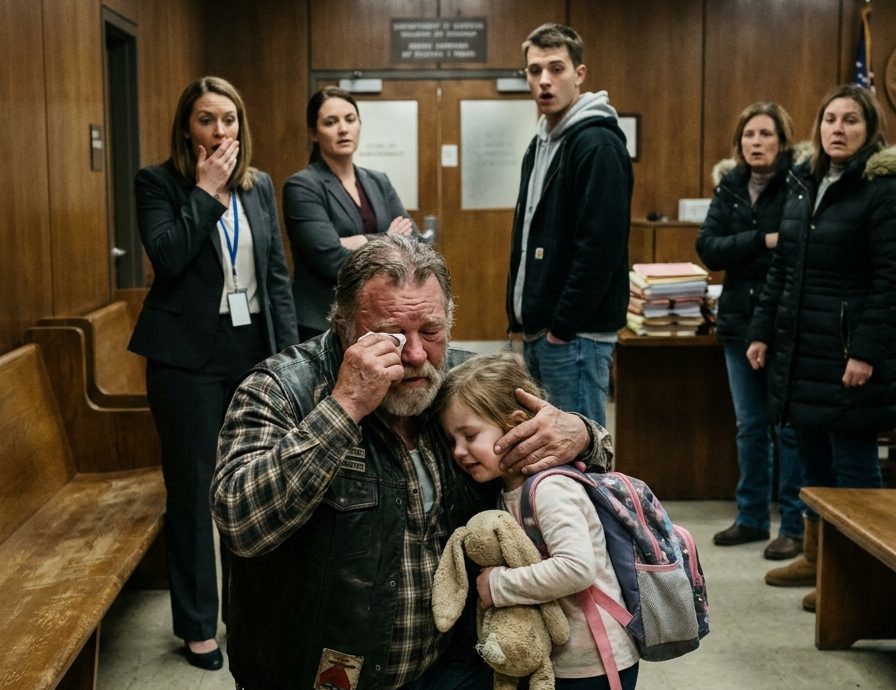
He had been standing near the door the whole time, quiet as ever, broad shoulders slightly hunched, work gloves tucked into one pocket. He cleared his throat once and said, “It wasn’t the child’s fault.” His voice was deep enough to shake the room, but it wasn’t angry. It was tired. “She saw me having a hard moment. That’s all.”
The principal looked uncomfortable. “Mr. Hale, we’re just trying to maintain appropriate boundaries—”
He shook his head once.
“No,” he said. “You’re trying to make this smaller than it is.”
That was when he told us about the picture on the wall.
It was part of the school’s Veterans Day display, one of those neat patriotic arrangements put together by a committee that probably thought remembrance was just paper stars and printed names. But buried in the middle of it was a photo from years ago, taken after a school fire in another county. Smoke-blackened brick. Fire trucks. Children wrapped in blankets. And near the edge of the image, barely visible unless you really looked, was a teenage boy being carried out through broken glass.
That boy was his nephew.
Mr. Hale had been a firefighter then. Young enough to still believe he could save everyone if he just moved fast enough. Strong enough to get thirteen children out alive. Not lucky enough to save the fourteenth.
“No one here knew,” he said quietly. “And I preferred it that way.”
The room went still after that.
He didn’t tell the story like someone asking for pity. That was what made it worse. He told it like a man who had long ago learned that grief becomes easier for other people to tolerate when you flatten it into facts. There had been a fire. There had been children trapped inside. He had gone in. He had made it out thirteen times. The last time, he found his nephew too late. That was all. Just facts. Just enough to explain why a memorial wall in a school hallway could break a man open in the middle of an ordinary workday.
My daughter, of course, had not cared about any of that. She hadn’t needed the full tragedy. She had just seen a grown man crying alone and done what felt right to her.
“Nobody should cry by themselves with a mop bucket.”
When I repeated her words in that office, the principal actually looked down.
By lunchtime, the note was gone from my daughter’s file. By the end of the day, the principal had asked if I would allow my daughter to speak privately with the counselor “just to process the emotional experience.” I nearly laughed at that. Process the emotional experience. As if my child was the fragile one in this equation. As if she were the one who needed to be professionally interpreted because she had done the radical thing of being kind.
Mr. Hale, meanwhile, returned to work like nothing had happened. That was almost the hardest part to watch. He didn’t storm out. Didn’t demand apologies. Didn’t suddenly become talkative or transformed. He just picked up his cart and continued down the hallway like grief was something he had already learned to carry without asking anyone to notice the weight of it.
But now people did notice.
That changed everything.
The next week, students started saying hello to him. Not all at once. Not dramatically. Just small things at first. A nod. A “morning, Mr. Hale.” A boy holding the door open for his cart. Two girls from the choir asking if he wanted one of the cupcakes left from rehearsal. The fear had gone out of the building, and once it did, what remained was embarrassment. Because children realized faster than adults did that they had helped turn a wounded man into a school ghost simply because he had a big voice, a scarred face, and preferred solitude.
The teachers changed too, though more slowly. One of them asked if he would help with the Veterans Day assembly the following year. Another apologized for never asking about his service. The school secretary started saving him a cup of coffee in the mornings. Even the principal began speaking to him with a softness that had not been there before, the kind that only appears after someone realizes they almost punished the wrong person for the wrong thing in the wrong moment.
My daughter didn’t make a big deal of any of it.
That was the beauty of her.
She kept being exactly who she was.
A week later, I found her sitting cross-legged in the kitchen drawing a picture of Mr. Hale with a giant mop and what looked like a firefighter helmet floating above his head like a halo. When I asked what it was, she shrugged and said, “That’s both versions of him.”
Both versions.
Children understand more than we give them credit for. She had already grasped something most adults miss entirely: people are rarely just the role you meet them in. Janitor. Firefighter. Veteran. Scary man. Quiet man. Grieving man. None of those was the whole truth. They were just different rooms inside the same person.
A few days before Thanksgiving, Mr. Hale stopped me near the pickup lane. He looked almost uncomfortable doing it, one hand gripping the handle of his cart, the other rubbing the back of his neck.
“I wanted to thank your daughter,” he said.
I smiled. “She’d be happy to hear that.”
He nodded, then looked out toward the buses for a moment before speaking again. “A lot of people thanked me over the years for the fire. Reporters. Chiefs. Families. But your little girl…” He paused, and I watched his throat work once. “She was the first person who saw me crying and didn’t ask me to explain it. She just made sure I wasn’t alone.”
That sentence stayed with me long after he walked away.
Because that was the real thing, wasn’t it?
Not the tragedy.
Not the record correction.
Not even the public redemption.
It was the fact that my daughter had offered comfort before information. Care before biography. She didn’t need the credentials to justify the tears. She didn’t need to know what he had survived to believe it mattered.
By Christmas break, the school had quietly added him to the holiday staff appreciation board. Not just maintenance. Not just janitorial services. By name. Mr. Thomas Hale. Veteran. Former firefighter. Beloved by students.
When my daughter saw it, she grinned so hard her whole face lit up.
“I told you he was nice,” she said.
And she had.
Of course she had.
Because children often see the truth first, before adults bury it under labels and discomfort and policy language. They see loneliness. They see gentleness. They see the parts of people that survive underneath everything hard.
The school thought it was writing up a child for inappropriate contact.
What it had really documented was the exact moment one little girl embarrassed an entire building by being more human than the adults running it.